
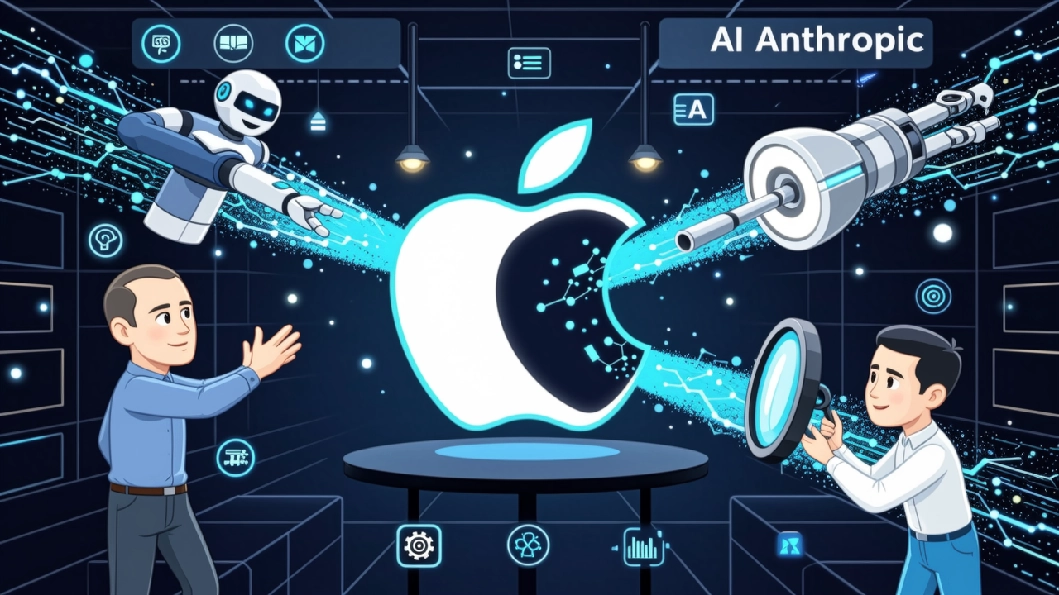
As an iPhone user, you’ve likely been bombarded with news about the explosive advancements in AI over the past two years. ChatGPT is constantly trending, Google updates Gemini more frequently than Android, Microsoft has deeply integrated Copilot into Office, and Meta has open-sourced Llama, fostering a “mass model-building” movement.
But when you open your iPhone, Mac, or iPad, where is Apple in all this?
This isn’t an illusion—Apple has genuinely fallen behind in the era of large language models. Siri only started its “brain transplant” in 2024, and the so-called “Apple Intelligence” is essentially just an AI-powered polish on existing system functions, with no groundbreaking products or model architectures in sight.
The problem isn’t a lack of money, talent, or chips at Apple. The company has trapped itself in a cage that is fundamentally incompatible with the AI ecosystem.
I. Apple’s “Delayed Reaction” to AI Isn’t Accidental; It’s Inevitable
While Google flaunts Gemini, Microsoft monetizes Copilot, Meta stakes its claim with Llama, Amazon sells AI as an enhancement for AWS, and even Tesla piles on computing power with Dojo for humanoid robots, what is Apple doing? Still repeating, “We don’t look at your data.”
It looks like a feature phone user telling the world, “Don’t be so radical; stability is key.”
But AI isn’t a camera, a chip, or a finely crafted aluminum casing. AI competes on data throughput, model capability, and the iteration speed of cloud computing power. Apple certainly knows this, but it is unwilling and unable to abandon its core principles: user privacy and a closed ecosystem.
This is like trying to win a straight-line sprint while following the rules of a bicycle race—you’ll never keep up.

II. Apple’s “Three Tenets” in AI: Privacy, On-Device, Local Closed-Loop
Apple’s AI philosophy can be brutally simplified into three statements:
- Data must not leave the device.
- Computing power must not rely on public clouds.
- Everything must operate within a closed Apple ecosystem.
Consequently, we see “Apple Intelligence” proudly introducing a Private Cloud Compute system, claiming it’s more secure than the cloud because user data isn’t stored, uploaded, or leaves any traces. In short: “We do AI without relying on your dirty data.”
But the question is: How powerful can AI become without that so-called “dirty data”?
Remember, GPT-4o consumes countless tokens daily; Gemini 2.5 Pro can reason across images, text, tables, and audio; even the “semi-open-source” Llama 3.3 has sparked a frenzy in the community. Running a large model locally on an iPhone 15 Pro with its A17 chip isn’t a challenge to Moore’s Law; it’s a test of the market’s patience.

III. Why Does Apple Insist on This Difficult Path?
Frankly, it stems from a long-standing “aesthetic obsession” at Apple—the desire to do everything in-house, keep everything secret, and integrate everything seamlessly.
This approach brought immense success in hardware and software: custom chips, closed systems, unified design. Each new iPhone generation sells steadily. But AI is a battlefield that doesn’t care about “aesthetics.” It’s more a product of hacker culture and cloud-native thinking: iterate first, polish later; launch first, reflect afterward.
As Ben Thompson pointedly noted, Apple’s “lag” in AI is because it still applies a “perfect product mindset” to a technological paradigm of “continuous service evolution.”
It’s like insisting on writing “elegant code” while the developer next to you finishes the task in one go using Copilot’s “Ctrl+Enter.”

IV. It’s Not That Apple Has No Moves Left; Its “AI Genes” Are Just Too Weak
Apple is aware of its shortcomings.
That’s why, beneath the seemingly confident surface of Apple Intelligence, it integrated ChatGPT into the system. When Siri can’t answer a question, it politely “invites ChatGPT to the rescue,” sometimes without even requiring a login.
Is this pragmatic? Certainly. But strategically, hasn’t Apple already admitted: “Our models aren’t strong enough; we need external help”?
This model might relieve pressure short-term, but long-term, isn’t it ceding its AI sovereignty? Once user habits form, it becomes difficult to steer them back to your own models.
Doesn’t this mirror Siri’s decline after losing to Alexa and Google Assistant—the once “all-powerful” intelligent assistant reduced to a voice-activated switch for “checking calendars and weather”?
V. Apple’s Dilemma: The Conflict Between a Closed Loop and an Open AI
Ultimately, most leaders in the AI era have chosen “openness.”
Google open-sources the Gemini SDK, Microsoft embeds Copilot into GitHub, M365, and even the Windows OS底层, Meta adopts “open-source + deployment + social platform integration.” These are classic “outward expansion” strategies.
Apple, however, persists with an “invitation-only” strategy—if you want to run AI here, you must pass our review, use our hardware, our APIs, and comply with our privacy policies.
This “firewall” design philosophy seems increasingly out of place in the AI era. In the world of open-source models, no single company can define the intelligent experience by “controlling the gateway.”
The ultimate irony is that when you use ChatGPT on your iPhone, the truly powerful part lies in the cloud, with OpenAI, and Azure’s computing power—not with Apple.

VI. Conclusion: It’s Not That Apple’s AI Is Inferior; It Just Chose the Wrong Path
Many argue that Apple’s lag in AI stems from conservatism, slow reactions, or diverted chip resources to Vision Pro. But I lean towards another view: Apple isn’t ignoring AI; it simply bet on the wrong direction.
It aims to build a “personal intelligent assistant under user privacy,” not an omnipotent, all-knowing “super AI.”
The problem is, most users now seek an AI that can “write my PPTs, edit my vlogs, plan my trips, or even help start a company with a single command.” This isn’t about “adequate” AI; it’s about “the more powerful, the better.”
While the entire industry races towards artificial general intelligence, Apple is meticulously polishing a “Siri that understands you.” This is destined to be an unequal contest.
In the future, Apple must either admit this path is unviable and pivot quickly, or deliver a “qualitatively stunning” experience with sufficiently powerful on-device AI capabilities. Otherwise, in the AI war, it might truly remain trapped by its own “closed loop.”