This site uses cookies. By continuing to browse the site you are agreeing to our use of cookies.Read our privacy policy>
This site uses cookies. By continuing to browse the site you are agreeing to our use of cookies.Read our privacy policy>
Dynamic Updates on Precision Data Center Air Conditioning, UPS Power Supplies, and Temperature/Humidity Control Products
Precision air conditioning units, UPS power supplies, and other data center equipment
Maintenance and Servicing of Data Center Air Conditioning and Precision Air Conditioning Systems

Here is the translation of the provided text into grammatically correct English, without any Chinese characters:
Current server network cabinets are rapidly evolving towards high density, intelligence, modularity, and green sustainability to meet the challenges posed by high-performance computing scenarios like Artificial Intelligence (AI).
The table below outlines their core development directions:
| Development Direction | Core Characteristics & Goals | Specific Manifestations |
|---|---|---|
| High Density & Liquid Cooling | Increase power density per cabinet to support higher computing power; address thermal challenges. | - Leap in Power Density: AI workloads are driving cabinet power from traditional levels towards hundreds of kilowatts or even megawatt levels. - Liquid Cooling as Key: Air cooling reaches its limit for cabinets exceeding 20-30kW. Liquid cooling solutions like direct-to-chip cooling and immersion cooling are increasingly becoming standard for high-density scenarios. |
| Standardization & Open Architecture | Improve compatibility, scalability, and deployment efficiency. | - Rise of 21-inch Open Racks: Compared to traditional 19-inch cabinets, the wider 21-inch design better accommodates the bulky cables and liquid cooling manifolds of AI servers, supports higher power, and offers improved airflow and thermal management. Major cloud providers are adopting this as a standard. - Modular Design: Using prefabricated standard modules (power, cooling, IT) for assembly can shorten data center construction cycles by up to 40% and enable flexible, on-demand expansion. |
| Intelligent Management | Enable refined operations and proactive warning. | - Integrated Sensors: Monitor parameters like temperature, humidity, and power consumption within the cabinet in real-time. - Digital Twin Technology: Creates a virtual replica, allowing for simulation and predictive maintenance of the physical cabinet, potentially reducing fault response times from hours to minutes. |
| Green & Sustainable | Reduce energy consumption and improve resource efficiency. | - Addressing High Energy Consumption: Data center global electricity consumption is projected to reach 3%-4% of the global total by 2030. - Technical Energy Savings: Technologies like contained hot/cold aisles, liquid cooling, and AI-optimized airflow can reduce Power Usage Effectiveness (PUE) to 1.15 or even lower. - Material & Energy Innovation: Use of aluminum frames (lighter weight, higher thermal conductivity) and exploration of renewable energy sources with microgrids. |
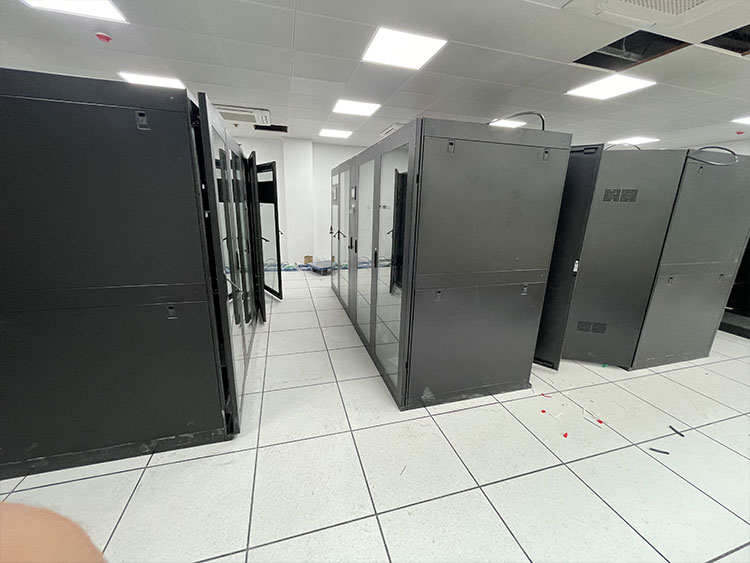
When planning or upgrading network cabinets for your enterprise, consider the following aspects:
Assess Business Needs: Identify whether your business involves internet AI training, financial high-frequency trading, or edge computing scenarios. Different scenarios have vastly different requirements for cabinet power density, latency, and physical dimensions.
Evaluate Technology Routes: If your projected power per cabinet exceeds 30kW, it is essential to incorporate liquid cooling technology into your plans. Also, evaluate whether 21-inch open racks offer better long-term return on investment.
Focus on Intelligent Features: When selecting cabinet products, prioritize solutions equipped with intelligent sensors and digital twin capabilities, as they can significantly improve operational efficiency and reduce downtime risks.
Consider Cost & Space: Advanced technologies like liquid cooling require higher upfront investment. Choose the most suitable solution based on your budget and data center physical space (e.g., ceiling height, floor load capacity). For instance, use taller 48U racks in space-constrained areas to improve space utilization.
We will contact you as soon as possible after submission.
Copyright © 2025 Verhi Technologies Co., Ltd. All rights reserved.