- Chilled Water versus Direct Expansion Cooling: The Short Answer
- How the Heat Rejection Path Differs
- Energy Efficiency and PUE Impact
- Maintenance, Water Treatment, and Refrigerant Quantities
- Redundancy and Risk: What Happens When Something Fails?
- Choosing Based on Facility Size, Climate, and Service Capability
- Final Thoughts: It's About Trade-offs, Not Absolutes
- Frequently Asked Questions
Chilled Water versus Direct Expansion Cooling: The Short Answer
The short answer is that chilled water versus direct expansion cooling comes down to scale and infrastructure. Chilled water systems cool large facilities more efficiently, while direct expansion (DX) units are simpler, cheaper to install, and easier to maintain in small or distributed spaces. Neither is universally better; the right choice depends on your cooling load, building constraints, and how much risk you're willing to carry.
Take a 500 kW IT load, for example. A DX setup might need several CRAC units, each with its own compressor and condenser, drawing more total power and requiring more floor space. A chilled water plant, by contrast, centralizes the heavy machinery—chillers, pumps, cooling towers—so the indoor units are just air handlers with coils and fans. That centralization is why chilled water tends to win at scale, but it also brings water treatment, piping, and more complex controls into the picture.

How the Heat Rejection Path Differs
In a DX system, refrigerant runs directly from the indoor evaporator coil to an outdoor condenser—often an air-cooled unit on the roof or beside the building. The compressor does the work of moving heat, and the refrigerant itself is the transport medium. That's a single, self-contained loop per unit, which is why DX is sometimes called a 'self-contained' system.
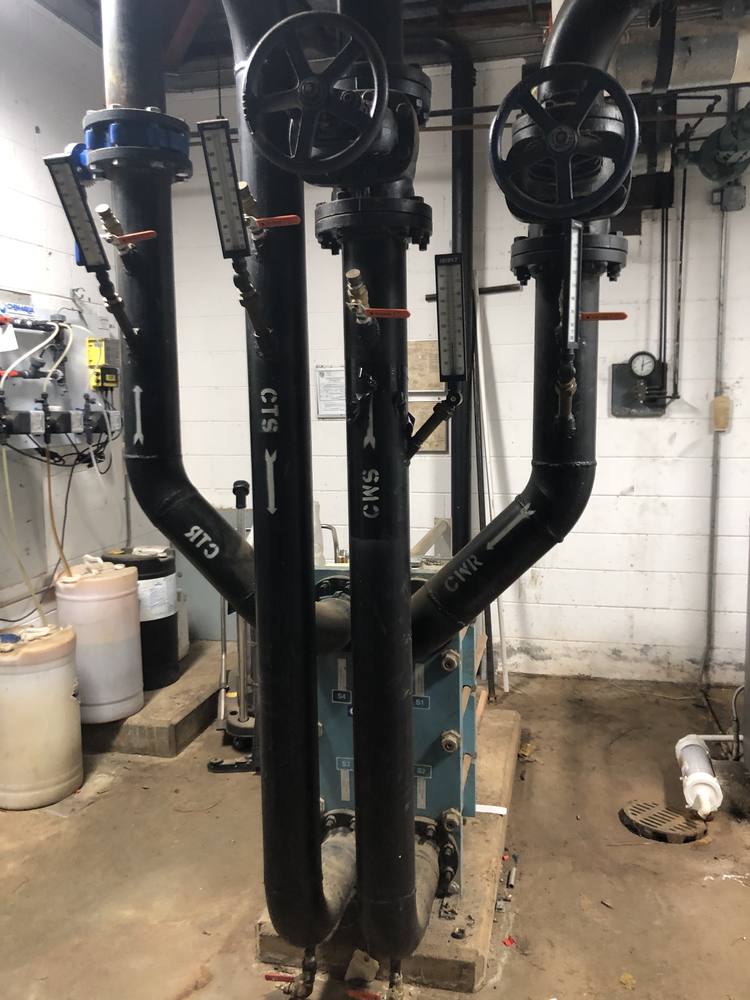
Chilled water systems split the job. The chiller produces cold water—typically 7–12°C (44–54°F)—and pumps it through insulated pipes to air handling units inside the data center. Those AHUs blow air across the water coils to cool the room. The refrigerant stays inside the chiller, so the only thing traveling long distances is water. That's a meaningful difference when your server room is on the fifth floor and the mechanical plant is in the basement.
For a 1 MW facility, the chilled water plant might use two 500 kW chillers in an N+1 configuration, each with a dedicated cooling tower. The indoor AHUs could be placed right next to the hot aisles, cutting fan energy and making containment easier. With DX, you'd need perhaps eight 60 kW CRAC units, each rejecting heat through its own condenser. That's more refrigerant lines running through the building—and more points where a leak could occur.

Energy Efficiency and PUE Impact
When engineers compare chilled water versus direct expansion cooling, efficiency is usually the first thing they look at. Chilled water systems can achieve lower PUE because they use water-side economization: when outdoor temperatures drop below about 10°C (50°F), you can bypass the chiller and cool the water directly with a cooling tower or dry cooler. That's a huge saving in mild climates.
DX systems, on the other hand, rely on compressor operation year-round unless you add refrigerant-side economizers, which are complex and still not as effective as water-side free cooling. In a place like Frankfurt or Chicago, a chilled water plant might run with the chiller off for 3,000 to 4,000 hours per year. That alone can cut annual cooling energy by 30–40% compared to a standard DX setup.
But don't assume chilled water is always more efficient. For small loads—say under 100 kW—the parasitic losses from pumps and the part-load inefficiency of a large chiller can eat away the gains. Modern DX units with variable-speed compressors and EC fans are surprisingly efficient at part load, often achieving an EER above 3.5 at 50% capacity. The real answer depends on your load profile, not just the nameplate.
| Parameter | Chilled Water | Direct Expansion |
|---|---|---|
| Heat rejection | Central chiller plant with water piping | Refrigerant lines to outdoor condensers |
| Indoor unit size | Compact AHUs with water coils | Larger CRAC units with compressors |
| Typical efficiency (PUE) | 1.2–1.4 with economization | 1.3–1.6 without economization |
| Maintenance | Water treatment, pump seals, chiller service | Compressor and refrigerant checks per unit |
| Refrigerant charge | Small, contained in chiller | Large, distributed across many units |
| Redundancy | Can share chillers and pumps | Per-unit redundancy often needed |
| Best for | Facilities above 500 kW | Small rooms, edge sites, retrofits |
Maintenance, Water Treatment, and Refrigerant Quantities
Maintenance is where the two approaches really diverge. A chilled water system demands regular attention to water chemistry—checking pH, conductivity, and biological growth—to prevent scaling and corrosion in the pipes and heat exchangers. If you skip that, you risk fouled coils and reduced heat transfer, which quietly drives up energy use. You also have more moving parts: pumps, valves, and the chiller's own refrigerant circuit.
DX units simplify the water side, but they put more refrigerant in the building. A typical 60 kW CRAC unit might hold 10–15 kg of R-410A or R-454B. Multiply that by eight units and you're managing over 100 kg of high-GWP refrigerant. Leaks aren't just an environmental concern; they also cause capacity loss and can shut down a unit if the charge drops too low. That's why many operators now prefer systems with lower charges or natural refrigerants like R-290, though those come with their own safety constraints.
For a chilled water plant, the refrigerant is confined to the chiller—often a couple of hundred kilograms for a 1 MW unit, but in one place. That makes leak detection and recovery simpler. The trade-off is that you now own a water treatment program. In practice, that means monthly testing, chemical dosing, and periodic cleaning of strainers and coils. If your team isn't comfortable with that, DX might be the lower-risk choice.

Redundancy and Risk: What Happens When Something Fails?
Redundancy is about what breaks and how fast you can fix it. With DX, each CRAC unit is independent, so a single compressor failure only takes out that unit's cooling zone—assuming you have N+1 units and enough capacity to cover the loss. That's a clear advantage for small rooms where you can't afford a full plant shutdown.
Chilled water systems centralize risk. If the chiller plant goes down, the whole data center loses cooling unless you have redundant chillers, pumps, and piping loops. That's why Tier III and Tier IV designs often use dual independent chilled water loops, each capable of carrying the full load. But that doubles the piping and valve count, which adds cost and complexity. For a 200 kW edge site, that level of redundancy is rarely justified—DX with a couple of spare units is often the pragmatic call.
There's also the question of maintenance windows. A DX unit can be serviced one at a time without affecting the others. A chiller might need to be taken offline for a compressor overhaul, which means you need enough capacity in the remaining chillers to carry the load—or you plan the work during a scheduled shutdown. That's a planning headache, but it's manageable if you have a good maintenance contract and a clear understanding of your load.
Choosing Based on Facility Size, Climate, and Service Capability
So how do you pick? Start with your IT load. For anything under 100 kW, DX is usually the simplest and most cost-effective. You can install a couple of CRAC units, connect them to power, and you're done. For loads above 500 kW, chilled water starts to pull ahead on efficiency and space, especially if you're building a new facility with room for a mechanical plant.
Climate matters too. In hot, humid regions like Singapore or Dubai, water-side economization offers little benefit, so the efficiency gap narrows. In those cases, DX might be attractive because it avoids water treatment in an environment where water is scarce. Conversely, in cool climates like the Nordics or Canada, a chilled water system with free cooling can achieve remarkably low PUEs—some operators report 1.15 or better.
Don't forget your service capability. If your team has strong mechanical and water treatment skills, chilled water is manageable. If you're relying on a small IT staff or a third-party HVAC contractor, DX units are easier to troubleshoot and repair. The same logic applies to existing infrastructure: if your building already has a chilled water loop from the HVAC system, tapping into it might be cheaper than installing new DX units. But if you're retrofitting an old office space, running new refrigerant lines might be simpler than installing a chiller and piping.
A practical example: a colocation provider in Dallas needed to cool a 1.2 MW hall. They chose chilled water with two 600 kW chillers and a waterside economizer. In that climate, they get about 2,500 hours of free cooling per year, cutting their annual cooling energy by roughly 25% compared to a DX baseline. But they also had to budget for a full-time facilities engineer to manage the water treatment and chiller maintenance.
On the other end, a small enterprise in a suburban office park needed to cool a 60 kW server room. They went with two 35 kW DX CRAC units in an N+1 configuration. Total installed cost was about half of what a chilled water system would have been, and their maintenance is just an annual filter change and refrigerant check. The PUE sits around 1.5, but for their size, that's acceptable.
Final Thoughts: It's About Trade-offs, Not Absolutes
There's no single 'best' cooling architecture. Chilled water versus direct expansion cooling is a trade-off between efficiency and simplicity, between centralized and distributed risk, and between long-term operating costs and upfront capital. The right answer depends on your specific load, location, and team.
If you're planning a new data center or upgrading an existing one, it's worth doing a side-by-side analysis with real load data and local climate figures. A good cooling partner can help you model both options and see which one pays off over a 10-year lifecycle. That's where VERHI comes in—we've helped operators on three continents make this exact call, and we're happy to share what we've learned.
Frequently Asked Questions
Which is more energy efficient: chilled water or direct expansion cooling?
For large facilities (above 500 kW), chilled water systems are typically more energy efficient, especially when they use water-side economization to take advantage of cool outdoor temperatures. For small loads, modern DX units with variable-speed compressors can be just as efficient, and they avoid the pump and water treatment energy penalties.
What are the maintenance differences between DX and chilled water systems?
DX systems require per-unit checks of refrigerant charge, compressors, and coils. Chilled water systems demand water quality testing, chemical treatment, and maintenance of pumps, valves, and the chiller itself. Chilled water is generally more maintenance-intensive, but it centralizes the heavy equipment in one place.
Can I retrofit an existing DX system to chilled water?
Yes, but it's rarely a direct swap. You'd need to add a chiller plant, piping, and water treatment, and replace the DX CRAC units with AHUs that have water coils. That's a major project, so it's usually only worth doing if you're expanding significantly or if your current system is nearing end of life.
How does redundancy differ between the two systems?
DX systems offer natural redundancy because each unit is independent; if one fails, the others continue cooling. Chilled water systems centralize risk, so you need redundant chillers, pumps, and piping loops to achieve the same level of availability. That adds cost but can be justified for large, mission-critical facilities.
Not sure which cooling architecture fits your project? VERHI's engineers can help you compare chilled water and DX options based on your load, climate, and budget.
Based on VERHI's engineering experience designing and deploying precision cooling systems for data centers across the Americas, Europe, and Central Asia. General industry practices are described; specific product performance should be confirmed with VERHI.